
BloodLinkEmergency Blood Coordination Platform
When the right message reaches the right person at the right time, a life can be saved.
BloodLink is a digital platform designed to connect hospitals, blood banks, donors and emergency blood requests through a coordinated system, helping critical information move faster when time matters most.
A Problem I Could Not Ignore
In 2019, I lost my younger brother, Mahamat, in Kélo, Chad. He urgently needed A‑negative blood.
We tried to find compatible blood, but the challenge was not simply finding blood—it was finding the right information and connecting the right people quickly enough.
Losing him left me with a question that I could not ignore:
How many other families are, or will be, in the same situation—searching urgently for compatible blood while precious time is being lost?
And what if, in some cases, the blood is available, but the right information never reaches the right person in time?
That question became the foundation of BloodLink.
BloodLink is designed to help hospitals, blood banks, donors, and emergency blood requests connect and coordinate more efficiently through technology.
Billa Ali Abakar, Founder
Mahamat’s story is where BloodLink began. The problem it represents is bigger than one family.
When Information Is Fragmented, Time Is Lost
In an emergency, finding compatible blood is only part of the challenge.
Blood availability, donor information, and emergency requests can be scattered across hospitals, blood banks, phone calls, WhatsApp groups, and paper records. A compatible donor may exist nearby, but finding and coordinating with that person quickly can be difficult.
Today
- Hospital
- Phone call
- Blood bank
- Another phone call
- Community contacts
- Time lost
With BloodLink
- Emergency request
- BloodLink
- Coordination
- Verification
- Healthcare response
Intended model, now being prepared for real-world testing.
5.2units of blood collected per 1,000 people in Chad
BloodLink is designed to help bring these disconnected processes into one coordinated digital environment.
The goal is simple: get the right information to the right person at the right time.
From an Idea to a Working Prototype
BloodLink began as a final-year Data Science project. Today it is a working prototype.
Emergency requests
Healthcare staff can submit urgent blood requests.
Donor matching
Suitable donors are identified using configured criteria.
Nearby donors
Donor location supports proximity-based coordination.
Blood inventory
Organizations manage their blood-stock information.
QR verification
Blood information can be checked with a QR code.
Real-time updates
Time-sensitive information is shared as it happens.
How BloodLink Works
- 01
Request
A healthcare facility submits an emergency blood request.
- 02
Identify
BloodLink identifies potentially suitable blood or donors according to configured criteria.
- 03
Coordinate
The system supports communication and location-based coordination.
- 04
Verify
Blood information can be checked through the verification workflow.
- 05
Respond
Healthcare teams coordinate the next steps for fulfilling the emergency request.
See BloodLink in Action
This is not just an idea. The system has been built.
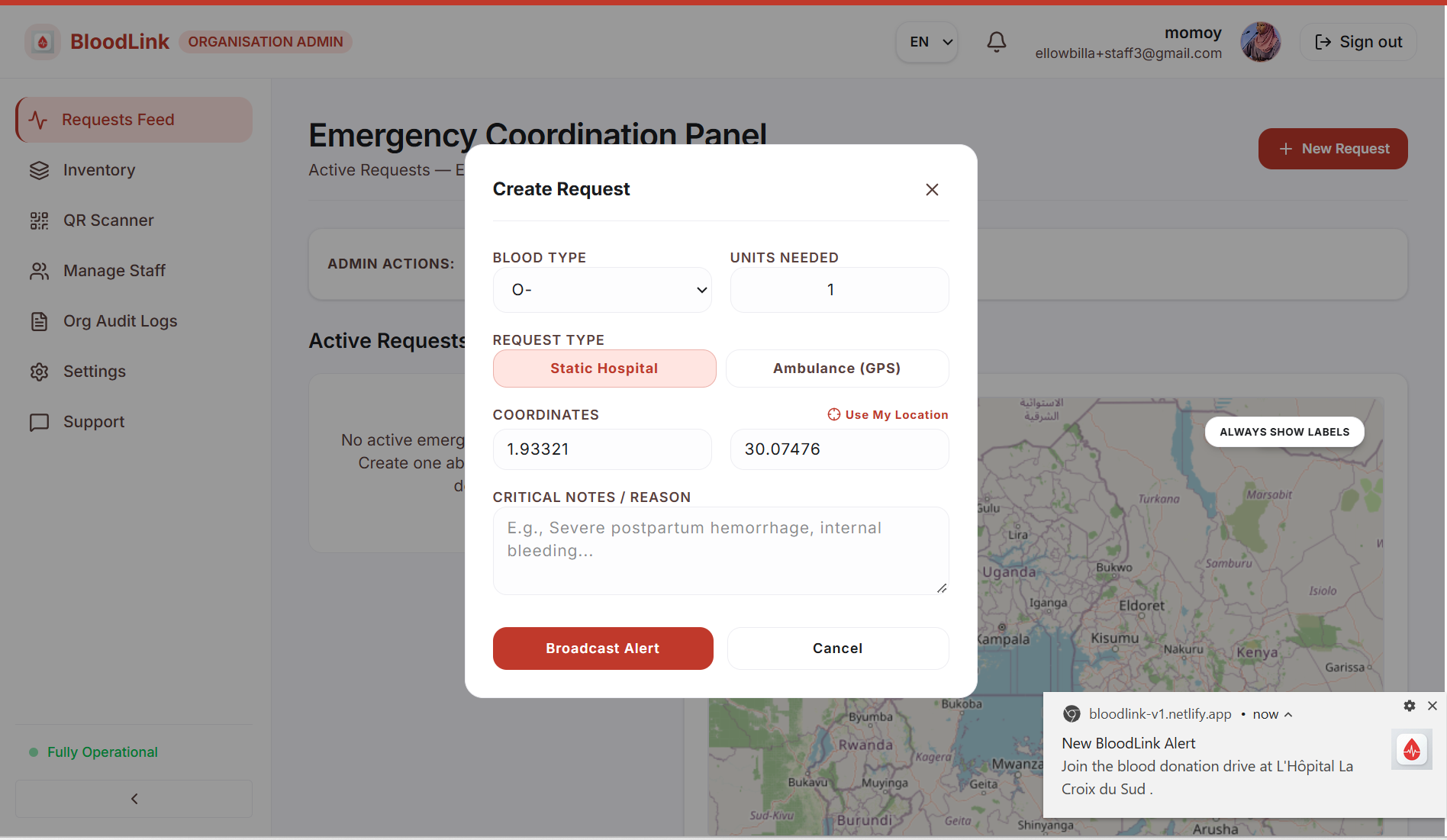
Healthcare staff submit an emergency blood request.
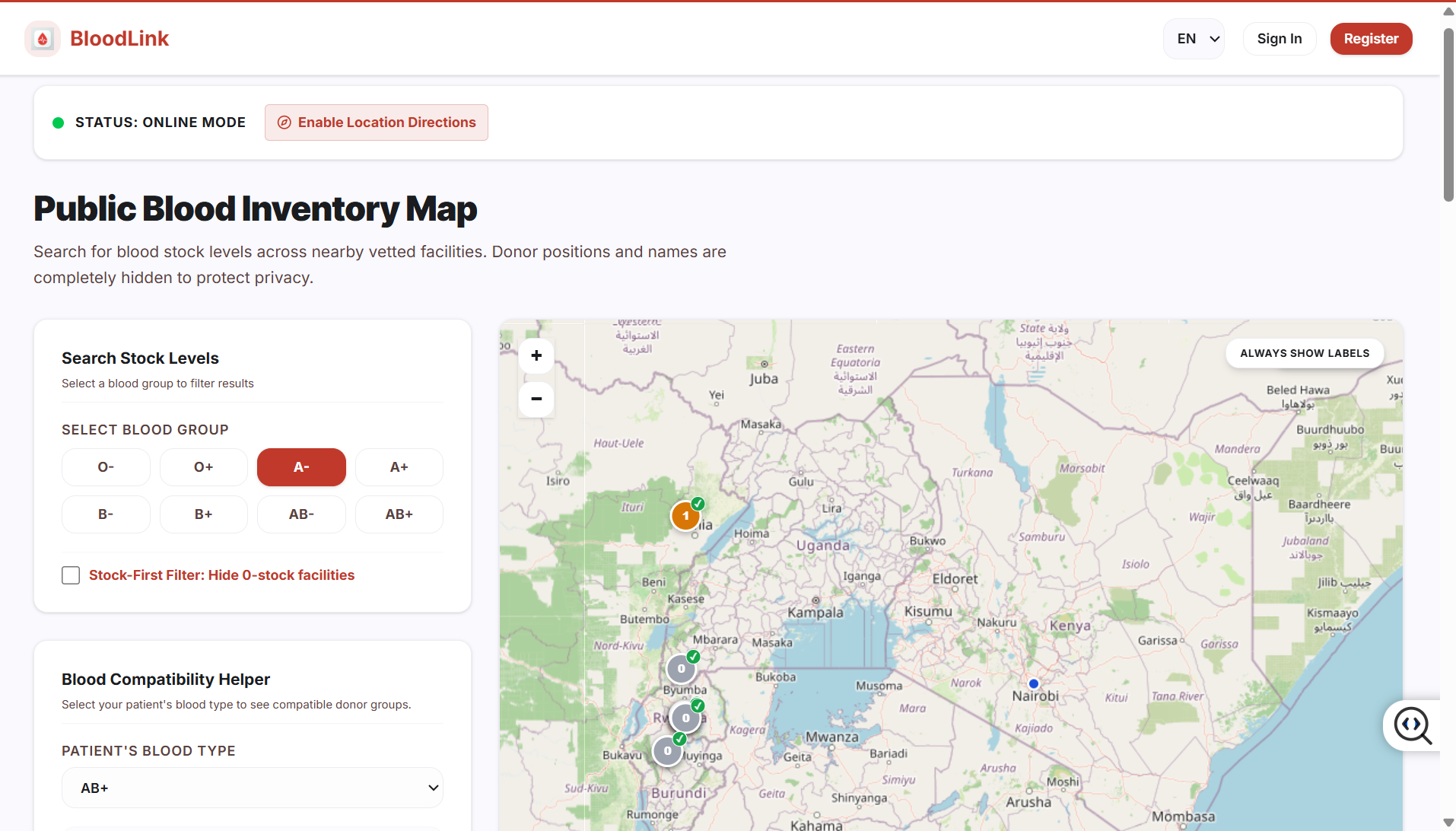
Suitable donors are identified, and their location supports proximity-based coordination.
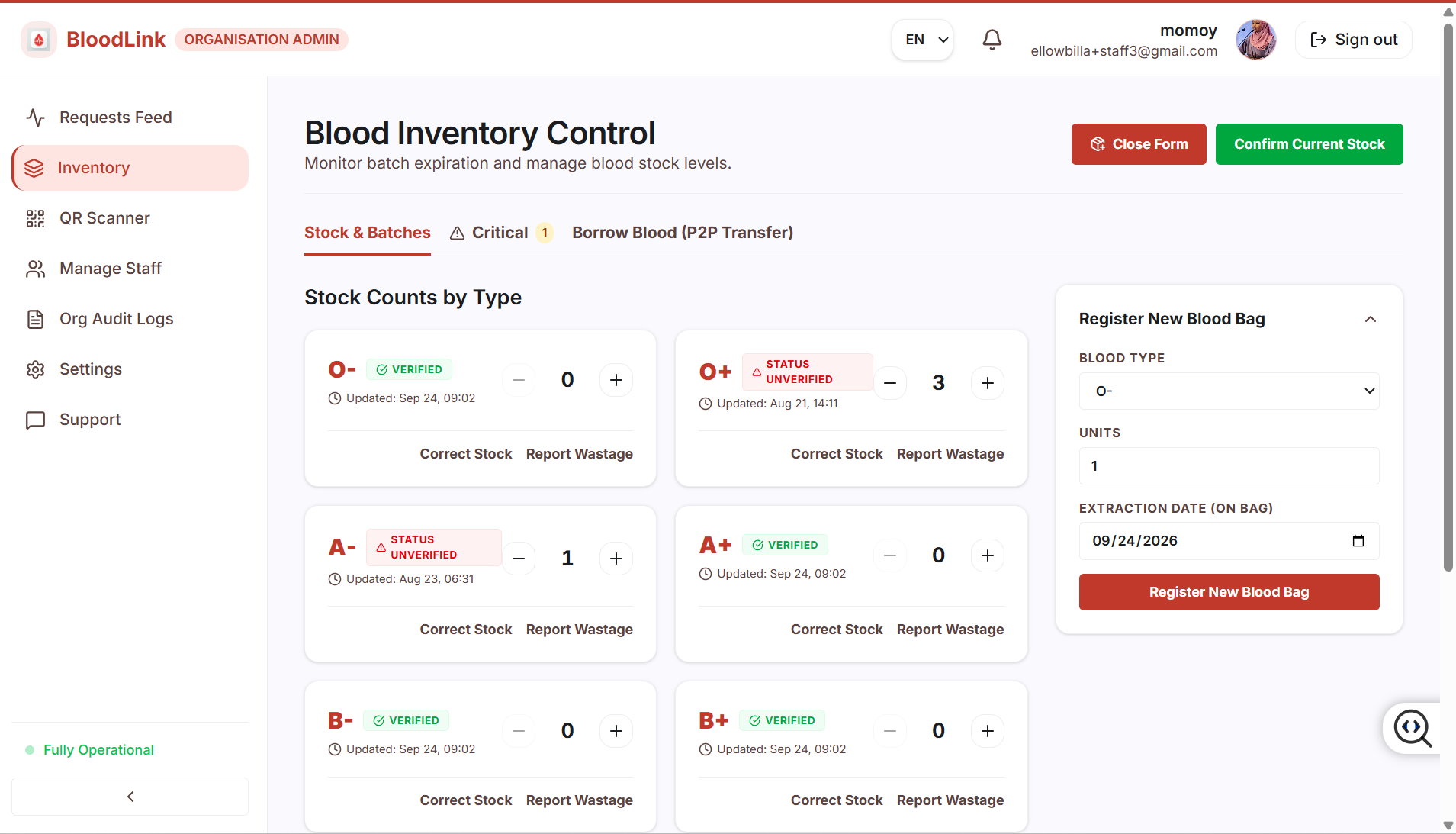
Organizations record and monitor their blood-stock information.
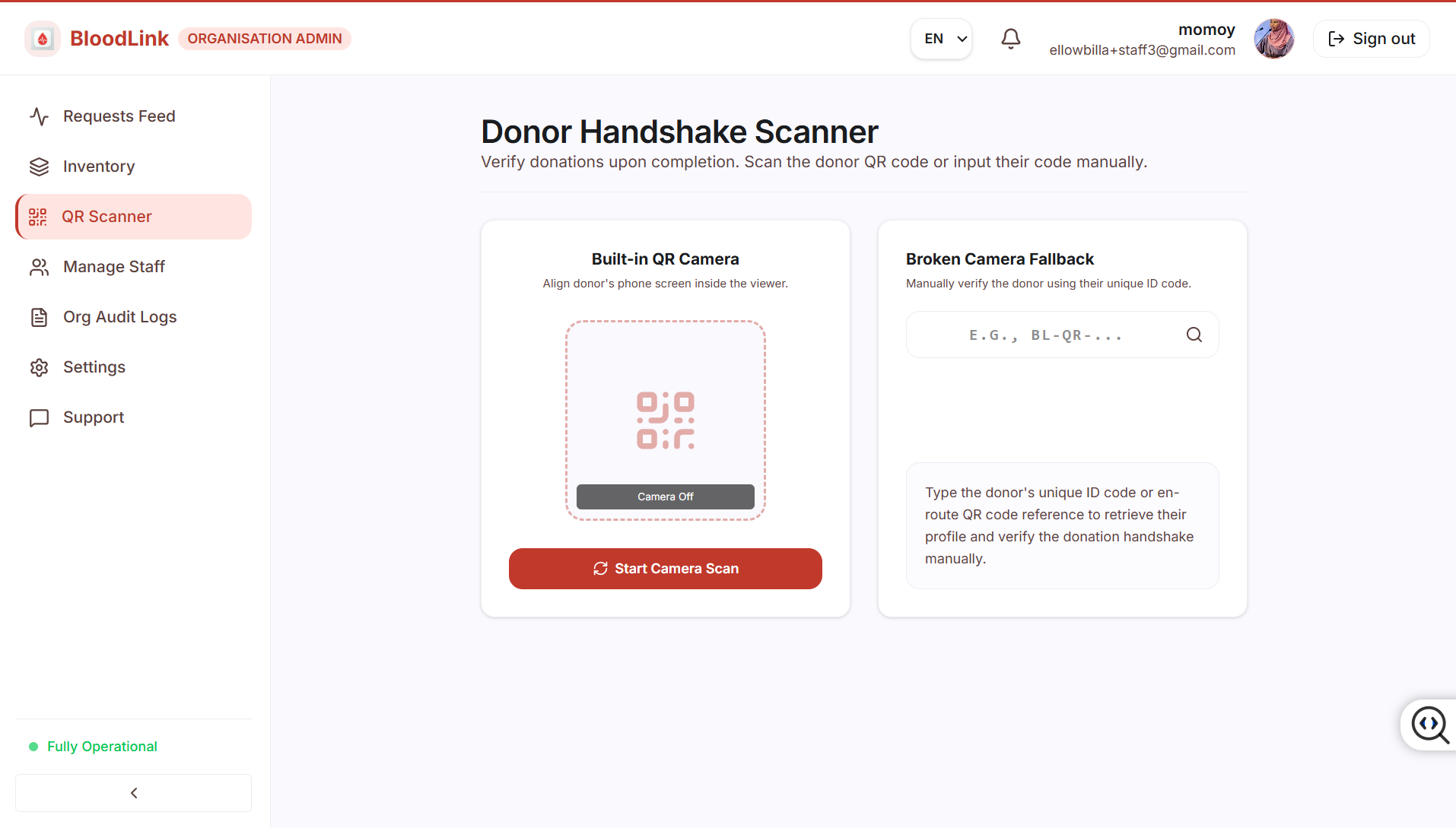
A QR code lets staff check blood information before it is given to a patient.
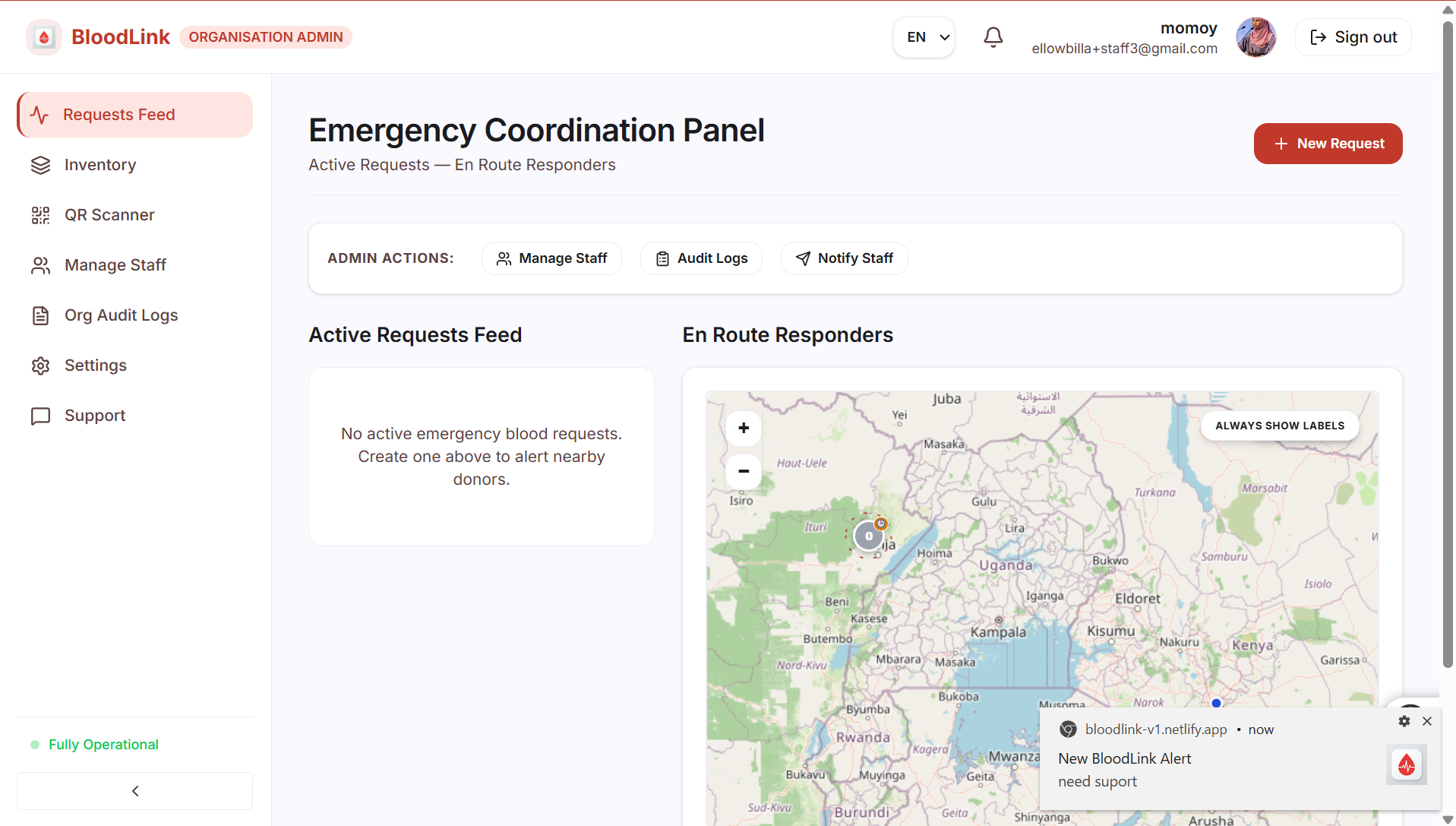
The operational dashboard used by healthcare organizations.
Built With Data & Technology
Frontend
- React
- Progressive Web App
Backend
- Node.js
Real-time
- Socket.IO
Database
- Supabase
- PostgreSQL
Mapping
- Leaflet
- OSRM
Data science
- Pipeline ready for future predictive models
BloodLink is designed to be data-driven. As real data becomes available, it can grow toward demand forecasting and decision support. AI does not make clinical decisions.
Where BloodLink Is Today
- Idea
- Build
- Test
- Validate
- Pilot
- Scale
Current position: validation and pilot preparation
Prototype completed (completed)
The core platform is built.
Academic validation (completed)
Defended as a final-year project at Kigali Independent University.
Technical testing (completed)
Core functions tested and improvements identified.
Real-world validation (in preparation)
Next: testing with healthcare professionals.
Pilot implementation (in preparation)
Next: a controlled pilot in a real healthcare setting.
The Next Chapter
The prototype is built. Now we need to learn how it performs in the real world.
- Step 1
Test
Test BloodLink with real users and realistic emergency scenarios.
- Step 2
Listen
Learn from doctors, nurses, blood-bank staff, hospitals and other stakeholders.
- Step 3
Improve
Fix technical, operational and workflow limitations.
- Step 4
Validate
Measure whether BloodLink can genuinely improve emergency blood coordination.
Starting in Chad.

Billa Ali Abakar
Founder, BloodLink
Meet the Founder
Billa Ali Abakar is a Data Scientist and digital innovation professional from Chad, with a background in data science, software development, and technology-driven problem solving.
Her journey with BloodLink began with a personal loss. In 2019, she lost her younger brother, Mahamat, in Kélo, Chad, after he urgently needed A‑negative blood. Despite efforts to find compatible blood, the challenge was finding the right information and connecting the right people in time.
That experience became the foundation of BloodLink.
While studying Data Science at Kigali Independent University, Billa turned this personal experience into a technology platform designed to connect hospitals, blood banks, donors, and emergency blood requests more efficiently.
Today, BloodLink is moving beyond its academic origins toward technical testing, real-world validation, and pilot preparation.
“When the right message reaches the right person at the right time, a life can be saved.”
Starting in Chad.Building for Africa.
Vision
To build an intelligent emergency blood access and delivery ecosystem for Africa, working toward a future where no patient dies because compatible blood could not be found or delivered in time.
Mission
To leverage AI, real-time logistics, mobile technology and data science to connect donors, hospitals, blood banks and patients faster and more efficiently across Africa, starting in Chad.
- Chad
- Regional coordination
- Africa
A long-term vision. The journey starts in Chad.

What guides BloodLink
- Human life above all
- Technology with purpose
- Transparency and accountability
- Speed and reliability in emergencies
- Inclusion and accessibility for all users
- Continuous learning and improvement
Help Take BloodLink Into the Real World
BloodLink is entering real-world testing. We are looking for people and organizations who can help us test, improve and responsibly implement it.
Hospitals
Potential pilot environments.
Get in touch as hospitalsBlood banks
Blood inventory and coordination workflows.
Get in touch as blood banksHealthcare professionals
Clinical and operational feedback.
Get in touch as healthcare professionalsPublic health organizations
Implementation and healthcare-system collaboration.
Get in touch as public health organizationsHumanitarian organizations
Emergency response and field applications.
Get in touch as humanitarian organizationsTechnology partners
Infrastructure, data, AI, logistics and technical collaboration.
Get in touch as technology partnersSupporters and investors
Responsible development and future scaling.
Get in touch as supporters and investors
Contact BloodLink
Tell us who you are and how you would like to be involved.